
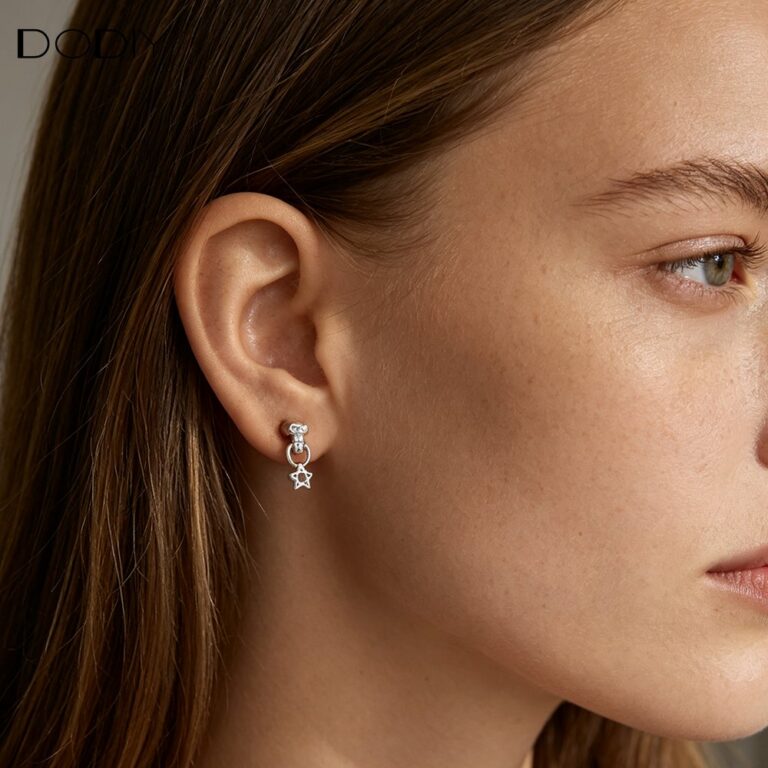
For a drop earring RFQ, ask what one quoted pair contains and attach a separate reference to each offered piece. Identify the pictured side and request the corresponding other piece before approving the combination. A wearing photograph of one ear can identify the visible design, but it does not establish the contents of a selling unit, a mirrored arrangement or an identical counterpart.
Use the wearing image to identify the enquiry
The selected official Tangmu Diy Jewelry reference shows an outlined star hanging below a small bright upper detail on one ear. Use those visible features to explain the appearance of interest. Send the image with the catalogue link and ask the supplier to identify the matching offered item. Where the catalogue wording describes different motifs, resolve that difference before applying the wording to a quotation.
Keep the description limited to appearance until the supplier answers the relevant item questions. A bright surface does not verify the metal, finish or identity of any decorative setting. A wearing image also does not establish the dimensions, fastening arrangement or suitability for a particular wearer. Those fields need separate confirmation for the exact offered version rather than assumptions drawn from the presentation.
Define the commercial unit before comparing prices
Ask the supplier to state whether its quotation is for an individual piece, a pair or another expressly described grouping. Retain the original quotation unit beside the buyer interpretation. The buyer should not convert a price into a price per pair without confirming the number and identity of the components covered. A product title alone is not the complete contents schedule.
Give the proposed components separate buyer references, such as piece A and piece B. Ask which supplier item or image corresponds to each reference. If both pieces are described with one design code, retain a view that shows the offered combination together. This makes a shortage question distinguishable from an offer that intentionally contains a different grouping.
Ask whether the pieces repeat, mirror or differ
State the relationship the buyer is requesting. A repeated motif, a mirrored arrangement and an intentionally different combination are separate possibilities to clarify. Do not assume that a view of one ear demonstrates the arrangement on the other ear. If the buyer requires a particular relationship, mark that request and obtain the supplier response before treating it as an offered feature.
For an orientation question, label the photographed side and request an identified view of the corresponding other piece. Ask the supplier to show both fronts in a consistent orientation. The objective is to identify the designs being compared, not to prescribe a way of wearing or modifying jewellery. A clear pair reference should remain understandable without reconstructing the direction of a cropped model photograph.
Build one pair-definition schedule
Use the same schedule for the initial enquiry, revised quotation and sample request. Fill in buyer requirements as requests, leaving the offered column open until the supplier confirms it. If a response changes the proposed combination, retain the previous reference and identify the replacement instead of silently overwriting one image.
Reference field | Buyer supplies | Supplier confirms
Main item | Catalogue link and marked wearing reference | Matching current offered item
Piece A | Visible motif and enquiry reference | Corresponding component identifier
Piece B | Requested relationship to piece A | Actual other component and image
Orientation | Repeated, mirrored or different arrangement requested | Offered combination in consistent views
Selling unit | Individual piece or pair required | Exact contents of one quoted unit
Exception | Any unacceptable substitution | Revised offer requiring buyer acceptance
Request a sample that represents the agreed combination
Specify whether the sample request concerns the complete offered pair or only one piece for an appearance discussion. Ask the supplier to identify which quotation option it represents. A single piece may answer a question about its visible motif while leaving the relationship between the components unresolved. Record that limitation instead of treating every sample as approval of a complete commercial unit.
During review, compare the supplied references with the component schedule and record any substitution. Acceptance of an appearance combination does not independently verify metal composition, decorative-stone identity, skin suitability or fastening performance. Keep additional purchasing requirements and the relevant supplier evidence separate from this limited design decision. Do not turn an attractive wearing image into a wider product guarantee.
• Identify every offered component before approving the quoted pair.
• Distinguish a requested arrangement from a confirmed supplier offer.
• Keep appearance approval separate from material and performance questions.
Carry the pair reference into the order handover
Send the accepted component schedule through the contact page with the selected catalogue references. Ask the supplier to state which images and quotation revision remain applicable. If one component changes, give the revised combination a new reference and identify whether the other component remains unchanged. Purchasing and receiving staff then have one defined combination to compare with the delivery paperwork.
Request current quantities, pricing, sample arrangements and timing for that identified offer rather than copying assumed conditions from a different product. The useful result is a clear definition of what is being discussed and what is being purchased. Open questions should remain visible until the supplier answers them; a neat pair label is not a substitute for an agreed contents record.
Frequently asked questions
Does a one-ear wearing photograph establish a complete pair?
No. It identifies the visible piece and its presentation. Ask what the quoted selling unit contains and request the corresponding other component reference before approving the complete combination.
Should the other earring be assumed to mirror the pictured one?
No. Explain the relationship the buyer requires and ask the supplier to show its offered arrangement. Repeated, mirrored and different components need clear references rather than an assumption based on one side.
What should happen when the catalogue name and picture differ?
Send the link and marked image together, describe the visible feature and ask for the matching current item. Do not transfer an unconfirmed motif or material description into the purchase specification.
Can pair approval verify materials or wearer suitability?
No. Approval of a component combination concerns the expressly reviewed appearance and contents. Any material, fastening or other applicable product requirement needs its own item-specific information and evidence.
Product and contact references
Product catalogue reference: https://dodiyjewelry.com/product/brass-skull-and-heart-drop-earrings/
Related catalogue reference: https://dodiyjewelry.com/product/brass-fishbone-and-crescent-moon-colorful-zircon-drop-earrings/
Contact Tangmu Diy Jewelry: https://dodiyjewelry.com/contact/
Tangmu Diy Jewelry blog: https://dodiyjewelry.com/blog/