
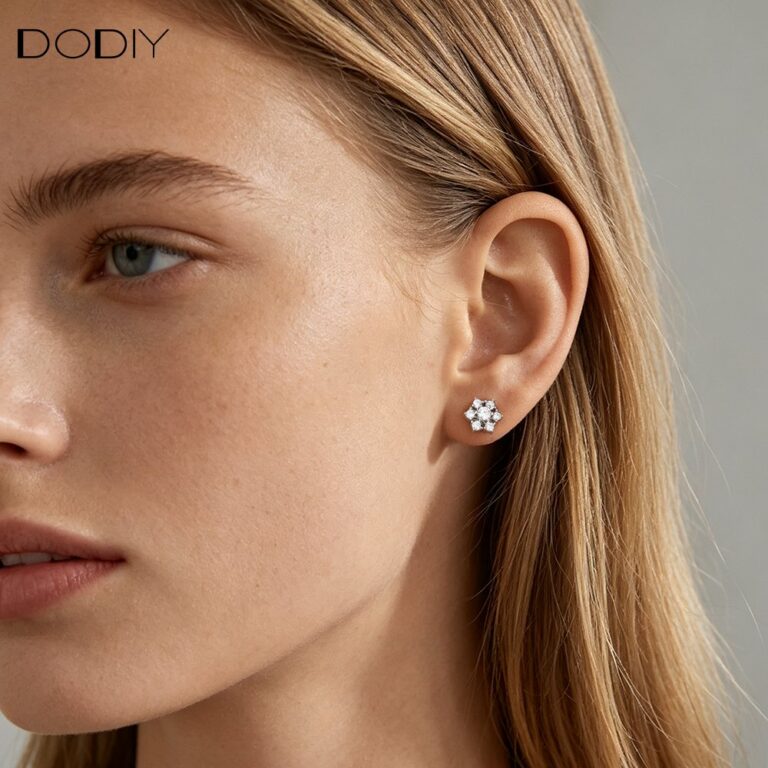
For a stud earring sample request, identify the selected front appearance and ask for rear and side views of the same offered item. Request the supplier description of any post, back or other fastening components actually included. A front-facing wearing photograph cannot establish the unseen construction, the supplied rear component or a material specification. Keep those questions open until the supplier identifies its offer.
Anchor every requested view to one front reference
The selected official Tangmu Diy Jewelry image shows a compact bright floral cluster at the ear from the front. That visible shape can identify the appearance being discussed. Send the catalogue link and the selected image together, asking the supplier to confirm the matching current item before supplying additional views. The picture does not independently identify its metal or decorative-stone composition.
Give the selected appearance a buyer reference and ask the supplier to retain its own item identifier beside it. Several fronts may look similar at a glance while belonging to different offered constructions. A rear image is useful only when its relationship to the selected front is clear. Do not combine photographs of unrelated pieces into a construction record merely because they share a floral theme.
Request the unseen faces as separate references
Label the front reference A, the rear reference B and a side reference C in the enquiry. Ask the supplier to show the same offered item in each view, with its identifier retained. A rear view can identify the visible arrangement behind the front, while a side view can explain the relationship between the front and the projecting or attached parts. These are information requests rather than assumptions about the construction.
If a separate rear component is part of the offer, request an identified view of that supplied component as well. Ask for it in the condition in which it is offered; this is not an instruction to alter or dismantle an item. The supplier should explain whether a photograph shows an included part, an optional alternative or a reference that does not belong to the proposed order.
Identify the fastening components before naming a specification
Ask the supplier how it names the offered fastening arrangement and which components accompany the selected item. Do not assign a familiar closure type solely from a front view. Where a post and a separate back are offered, request their item-specific descriptions and ask how the supplier identifies the corresponding combination. The enquiry should distinguish the main piece from any separately quoted rear component.
Keep dimensions as confirmation fields when they matter to the purchase. Ask the supplier to identify the relevant feature and provide its applicable measurement basis or drawing. Do not derive a post diameter, projection length or rear-component size from the model image. A photograph can locate a question without supplying a reliable scale or an agreed dimensional specification.
Use a view-to-component comparison table
Record which questions each image answers and which remain outstanding. This prevents a clear front photograph from being treated as evidence for every hidden feature. If the supplier offers more than one construction, give each option a separate row or schedule rather than mixing its views with the original request.
Reference | Question to send | Response to retain
Item identity | Which offered item matches the selected front? | Supplier identifier tied to the image
Front A | Which visible motif is selected? | Identified offered front view
Rear B | What arrangement is behind this same front? | Same-item rear view and description
Side C | How are the visible parts positioned? | Identified side view without assumed dimensions
Separate component | Which rear component, if any, is included? | Offered part identity and inclusion status
Open specification | Which material or dimension fields remain unanswered? | Item-specific supplier information or drawing
Make sample approval match its stated scope
State why the sample is being requested and which offered construction it should represent. If the purpose is to review the visible front and identify the rear components, record that limited purpose. Ask the supplier to identify any differences between the sample and the quoted version. An alternative back or a different attachment arrangement should not enter the approved record without being named.
Compare the sample references, supplied parts and relevant descriptions together. Approval of those observed details does not establish fastening retention, skin suitability, metal composition or any applicable compliance result. Where an order requires additional information or a defined validation process, request the relevant item-specific basis separately. No performance result should be invented from the fact that a sample has been photographed.
• Connect front, rear and side views to the same offered item.
• Identify included rear components separately from optional alternatives.
• Leave unseen or unanswered fields open instead of filling them from appearance.
Keep construction revisions visible in the purchasing record
When a supplier proposes a revised component or attachment arrangement, ask which references are replaced and which remain valid. Give the revised option its own quotation reference. Retain the accepted front, rear and side views with the corresponding offer so that a later image change does not silently substitute a different construction behind the same visible motif.
Send the view schedule through the contact page with the product reference and a list of unanswered purchase fields. Ask for current quantities, prices and timing for that identified option, without treating those commercial terms as established by the catalogue. The result is a traceable description of the requested sample and its supplied components, with appearance, construction information and additional product requirements kept clear.
Frequently asked questions
Does a front photograph prove that a post and back are included?
No. Ask the supplier to identify the fastening arrangement and list the components included with the exact offered item. A front view does not establish the unseen parts or their commercial inclusion.
Can a rear image from a similar design answer the question?
Only if the supplier expressly identifies that image as representing the construction offered for the selected item. Keep its relationship to the exact front and quotation clear; a similar motif alone is insufficient.
Should dimensions be calculated from the wearing image?
No. Use the photograph to locate the feature being discussed, then request the applicable supplier dimensions and measurement basis or drawing. The model presentation does not provide an agreed product scale.
Does accepting the sample establish skin suitability or fastening performance?
No. A limited sample review records its stated appearance and component observations. Any other relevant requirement needs separate item-specific information, evidence or an agreed validation process.
Product and contact references
Product catalogue reference: https://dodiyjewelry.com/product/brass-floral-zircon-stud-earrings/
Related catalogue reference: https://dodiyjewelry.com/product/brass-moonstone-stud-earrings/
Contact Tangmu Diy Jewelry: https://dodiyjewelry.com/contact/
Tangmu Diy Jewelry blog: https://dodiyjewelry.com/blog/